How Brands Can Build More Inclusive Campaigns: A Practical Guide for Modern Marketing Teams
How Brands Can Build More Inclusive Campaigns
Consumers are increasingly conscious of whether the brands they buy from genuinely reflect the people they serve.
For fashion, beauty, lifestyle and retail brands in particular, representation is often visible before a customer ever reads the copy or explores the product.
It appears in the people used in advertising.
It appears in campaign photography.
It appears across ecommerce imagery, social media, video, email marketing and other customer touchpoints.
That makes inclusive marketing more than a casting decision.
A genuinely inclusive campaign starts with understanding the audience, considering who is represented, and making sure that representation fits naturally within the wider creative strategy.
For brands, the objective should not simply be to make a campaign appear diverse.
It should be to create work that feels relevant, credible and representative of the people the brand wants to reach.
At Ms Curvaceous, we work with brands, retailers, agencies, photographers and creative teams looking to book professional plus size and curvy models for commercial campaigns, ecommerce, advertising, editorial projects, events and other productions.
Here are practical ways brands can approach inclusive campaign planning more effectively.
What Does an Inclusive Campaign Actually Mean?
An inclusive campaign is one that deliberately considers whether the people represented in the creative work reflect the audiences the brand wants to communicate with.
That can involve representation across areas such as:
Body size
Age
Gender
Skin tone
Ethnicity
Disability
Personal style
Different physical characteristics
Different customer experiences
The appropriate mix will depend on the brand, product, audience and campaign.
There is no universal checklist that guarantees inclusivity.
A campaign can include several different types of people and still feel disconnected from the audience if the representation is superficial or inconsistent with the brand.
The stronger approach is to begin with a simple question:
Who are our customers, and do they see themselves represented in the way we present our brand?
1. Start With the Audience, Not the Casting Call
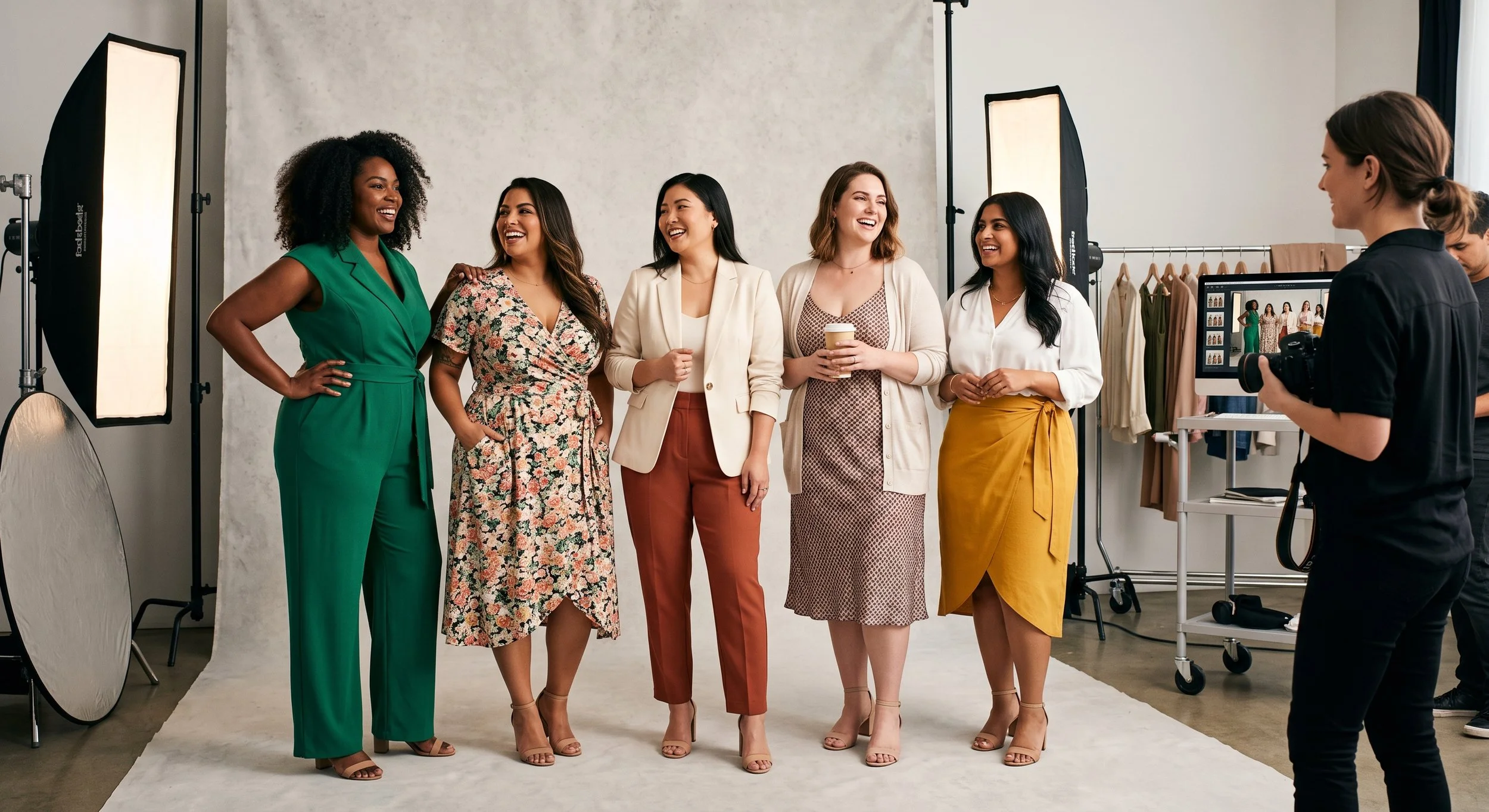
One of the easiest mistakes a brand can make is to begin with:
“Which models should we book?”
A better starting point is:
“Who are we trying to reach?”
Understanding the customer gives the creative and casting team a much clearer foundation.
Consider:
Who purchases the product?
Who influences the purchase?
What age groups are represented within the audience?
What does the customer actually look like?
Which communities are currently underrepresented?
Are there particular customer groups the brand is trying to attract?
Does the current brand imagery reflect the actual customer base?
The answers should influence the creative direction before specific models are selected.
This creates a more intentional process than choosing diversity after the campaign concept has already been finalised.
2. Make Representation Part of the Campaign Strategy
Inclusive representation works better when it is considered from the beginning.
If a brand develops an entire campaign around one narrow audience and then tries to add different forms of representation at the last stage, the result can feel disconnected.
Instead, consider representation when planning:
Creative concepts
Campaign locations
Styling
Photography
Video
Model casting
Product presentation
Social content
Ecommerce imagery
Advertising placements
This helps different elements of the campaign work together.
It also makes it easier for everyone involved to understand the type of casting required.
3. Be Specific About What You Want to Represent
“Inclusive” is a broad term.
A casting brief becomes much more useful when the brand explains what representation means for that particular campaign.
For example, a fashion retailer may want to demonstrate that a collection is available across a wider range of sizes.
A beauty brand may want its campaign imagery to reflect a broader range of skin tones.
A lifestyle company may want to feature models from different age groups.
The point is not to include every possible demographic in every campaign.
It is to identify what representation is relevant to the product, audience and objective.
A clear brief might therefore explain:
The target audience
The campaign objective
The visual direction
The product
The customer groups being represented
The desired model range
The type of content being created
That gives an agency and creative team something concrete to work with.
4. Cast for Authenticity, Not Just Appearance
A model can technically fit a casting requirement while still feeling wrong for the campaign.
Inclusive casting should therefore look beyond a checklist.
Ask:
Does this person make sense for the story we're trying to tell?
Consider:
Their overall presence
Their relationship to the product
Their ability to communicate naturally on camera
Relevant professional experience
How they work with other people in the campaign
Whether the creative concept suits them
Whether the representation feels credible within the context
For example, if a brand is promoting an extended-size collection, using plus size models should not feel like an afterthought.
The styling, photography, product presentation and overall campaign message should support the same idea.
Representation is strongest when the entire campaign is aligned.
5. Work With Professional Models Who Understand Commercial Production
Inclusive campaigns still need to perform commercially.
The people featured in the campaign need to work effectively in the production environment.
Depending on the project, the model may need to:
Follow direction
Work with photographers
Move naturally between poses
Present products effectively
Maintain consistency across multiple images
Work within a production schedule
Participate in video
Interact naturally with other models or talent
Professional experience can therefore matter just as much in an inclusive campaign as it does in any other commercial production.
The goal is to combine representation with professional suitability.
6. Think Beyond a Single Hero Image
One inclusive image rarely changes the perception of an entire brand.
Customers experience brands across multiple channels.
That means representation can be considered across:
Homepage imagery
Product photography
Campaign photography
Paid advertising
Organic social media
Email marketing
Landing pages
Video
Lookbooks
Editorial content
Events
Seasonal campaigns
A brand may have one diverse campaign image and still have a website where almost every other visual represents a completely different audience.
Consistency matters.
Customers notice what a brand repeatedly shows them.
7. Review Your Existing Image Library
Before organising another campaign, look at what the brand is already publishing.
Review:
Website imagery
Ecommerce photography
Social feeds
Previous campaigns
Paid advertising
Email creatives
Press imagery
Then ask:
What patterns do we see?
Are certain body types consistently represented while others are rarely visible?
Are different customer groups only represented during particular awareness months?
Are inclusive images used in social content but not on core product pages?
Does the brand's imagery reflect the people it claims to serve?
This kind of review can reveal gaps that are difficult to see when looking at individual campaigns in isolation.
8. Make Plus Size Representation Part of the Main Campaign
For brands selling clothing or products to plus size customers, representation should not automatically be separated into a special campaign.
Where appropriate, plus size models can appear as part of the main brand photography and advertising strategy.
That can help communicate something much stronger:
These customers are part of our brand, not a separate audience we occasionally remember.
For fashion retailers in particular, this can mean considering plus size models in:
Main seasonal campaigns
Ecommerce photography
Paid social advertising
Product launches
Brand campaigns
Editorial content
Website banners
Social media campaigns
The exact approach depends on the brand's product range and creative direction, but consistency is key.
9. Avoid Tokenism
One of the biggest risks in inclusive marketing is tokenism.
Tokenism happens when representation appears to have been added primarily to create the appearance of diversity rather than because the people represented genuinely belong within the campaign.
It can be noticeable when:
One underrepresented model appears in an otherwise uniform campaign
Different groups are used only during specific awareness periods
Diverse talent is shown but not meaningfully incorporated into the campaign
Inclusive imagery appears in advertising but not elsewhere in the brand
The creative concept itself does not support the stated message
The solution is not simply to add more people.
The solution is to make representation meaningful and integrated.
10. Make Sure the Product Is Actually Inclusive
Marketing cannot completely compensate for an exclusionary product experience.
For fashion brands, for example, there is an important relationship between representation and the actual product offering.
If a brand uses plus size models in advertising but provides limited sizing, customers may see a disconnect between the campaign and the shopping experience.
Inclusive marketing therefore works best when the wider customer journey supports the message.
Consider:
Product availability
Size ranges
Fit information
Product photography
Model measurements
Website experience
Customer service
Returns information
Accessibility
Brand communications
The campaign is one part of the overall brand experience.
11. Build a Better Model Casting Brief
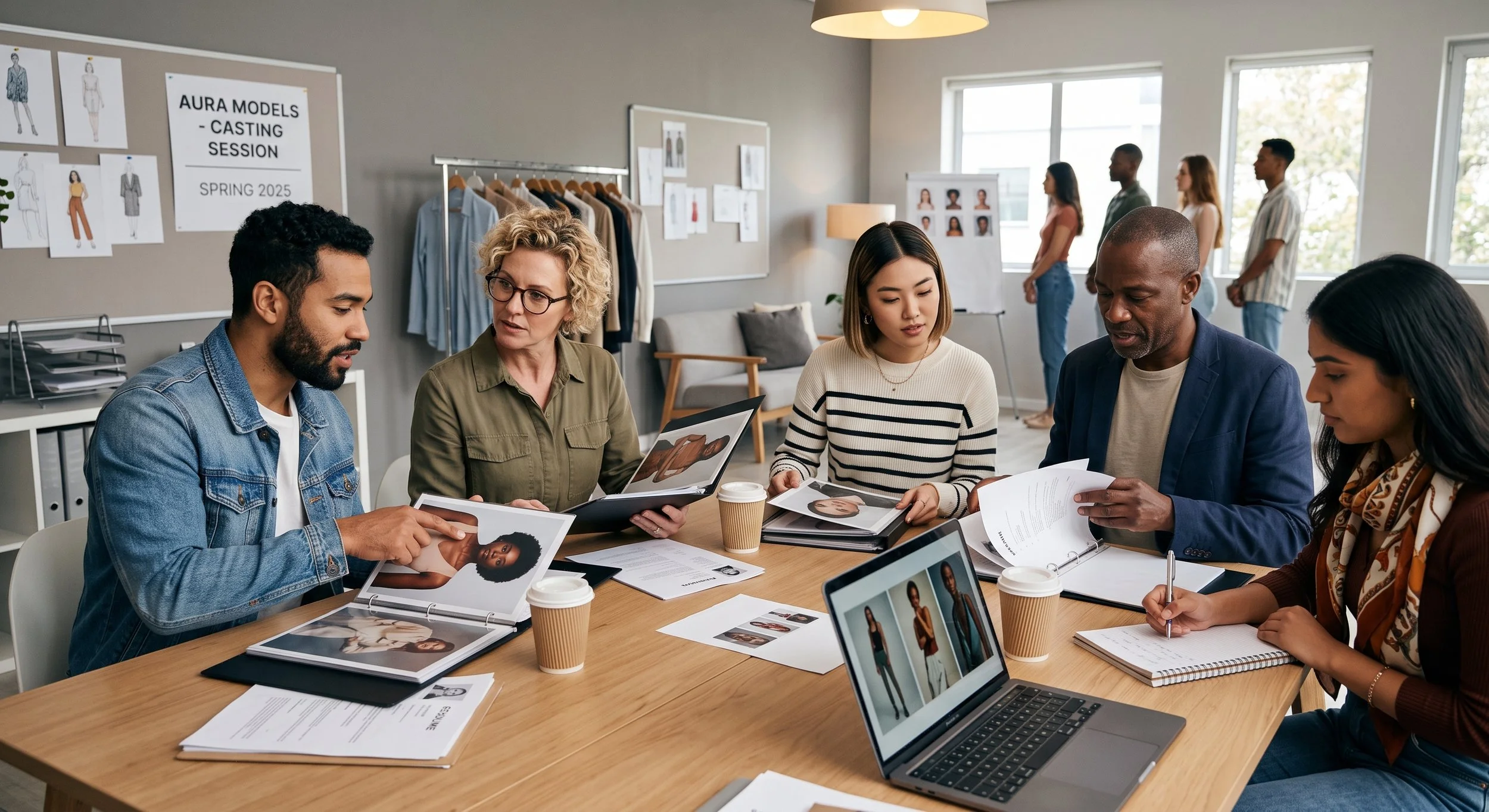
A strong casting brief can make inclusive campaign planning significantly easier.
Instead of simply saying:
“We need diverse models.”
Provide useful context.
For example:
Campaign objective
What are you trying to communicate?
Target audience
Who is the campaign aimed at?
Product
What will the models be wearing or demonstrating?
Representation
What customer groups should the campaign reflect?
Model requirements
Are there specific size, age, height, location or experience requirements?
Content
Will the models appear in:
Photography?
Video?
Ecommerce?
Advertising?
Social media?
Editorial content?
Location and date
Where and when is the production taking place?
Usage
Where will the resulting content appear and for how long?
A detailed brief allows the casting process to become more strategic.
12. Use Different Models Across Different Campaigns
There is no need for every campaign to use the same representation in exactly the same way.
A brand can build a broader and more natural picture of its customer base over time by working with different professional models across campaigns.
For example, one campaign might feature:
Several plus size models
Different age groups
Different visual styles
Another might place greater emphasis on:
Lifestyle representation
Different skin tones
Different body shapes
Different customer demographics
The goal is not to make every campaign identical.
The goal is to ensure that the brand's overall visual identity does not repeatedly exclude the same groups.
13. Give Creative Teams Enough Time to Cast Properly
Inclusive casting should not be squeezed into the final few days before a shoot.
When the production schedule is rushed, teams often default to whoever is immediately available.
That can reduce choice.
Starting earlier provides more time to:
Understand the brief
Identify suitable models
Review portfolios
Check availability
Consider alternatives
Confirm measurements
Coordinate logistics
Align casting with styling and production
For important campaigns, model casting should therefore be built into the project timeline from the beginning.
14. Work With a Specialist Model Agency When the Brief Is Specific
Some campaigns have straightforward requirements.
Others are highly specific.
A specialist model agency can be useful when a brand needs help identifying talent that fits a combination of requirements such as:
Plus size
Commercial experience
Specific clothing size
Particular location
Campaign experience
Ecommerce experience
Lifestyle presence
Specific dates
Instead of asking a creative team to search through multiple sources independently, a booking agency can help narrow the search to relevant professional talent.
For brands looking to book professional plus size models, a clear agency brief can make this process much more efficient.
15. Make Inclusive Campaigns Look Like Your Brand
Inclusion should not require a brand to abandon its visual identity.
A premium brand can still look premium.
A streetwear label can still look distinctive.
A minimalist brand can still maintain its aesthetic.
The question is how representation is integrated into the existing creative language.
Consider:
Lighting
Styling
Location
Colour
Composition
Art direction
Editing
Posing
Tone of voice
The same brand identity can be applied while broadening who gets to be represented within it.
That is often more effective than creating an entirely separate visual style for "inclusive" campaigns.
16. Consider the Full Customer Journey
Inclusive representation should extend beyond the campaign itself.
Review what a customer sees after clicking the advertisement.
For example:
Ad → Landing Page → Product Page → Checkout
If the advertisement shows a diverse customer base but the landing page immediately returns to a much narrower visual representation, the customer journey feels inconsistent.
The same applies to social media, email and ecommerce.
A strong campaign should connect to a wider brand experience.
17. Measure More Than Engagement
A campaign should still be measured commercially.
Depending on the objective, useful metrics can include:
Reach
Impressions
Engagement
Video views
Click-through rate
Website traffic
Product views
Conversion rate
Sales
Customer acquisition
Audience growth
Repeat purchase behaviour
Brands can also pay attention to qualitative feedback.
Are customers commenting positively on the representation?
Are people saying they finally see themselves reflected in the brand?
Are particular customer groups responding more strongly to the campaign?
These signals can help inform future creative decisions.
Inclusive Campaigns Are Better When Representation Is Consistent
The strongest brands do not treat inclusivity as a one-off campaign theme.
They build representation into the way the brand communicates over time.
That does not mean every campaign needs to look the same.
It means the overall brand should consistently communicate that different customers belong within the world it creates.
For fashion and retail brands, this can be particularly important because customers often make decisions based on whether they can picture themselves wearing or using the product.
When a customer can see someone who looks like them represented naturally and confidently, the product can become easier to imagine in their own life.
How to Plan an Inclusive Fashion Campaign
A simple planning process can look like this:
Before the campaign
Define:
Campaign objective
Target customer
Product
Creative direction
Representation goals
Model requirements
Budget
Location
Timeline
During casting
Review:
Portfolio
Experience
Visual fit
Measurements
Availability
Location
Professional suitability
During production
Make sure:
Models are appropriately styled
The creative direction is consistent
Products are presented accurately
Everyone understands the brief
The production environment is professional
Different models have meaningful roles within the creative
After the campaign
Review:
Performance
Customer reaction
Representation
Creative consistency
Commercial outcomes
Opportunities for improvement
This creates a repeatable approach rather than relying on last-minute decisions.
What Brands Should Avoid When Building Inclusive Campaigns
There are several common mistakes worth avoiding.
Using diversity as a marketing prop
Representation should have a genuine connection to the campaign rather than being added simply for appearance.
Relying on stereotypes
A diverse campaign can still be poorly executed if the people represented are reduced to predictable stereotypes.
Treating inclusive casting as an afterthought
The earlier representation is considered, the easier it becomes to integrate it naturally.
Choosing models only because they meet a demographic requirement
Professional suitability and campaign fit still matter.
Creating inclusive imagery that does not match the actual product
The customer experience should support the campaign message.
Focusing only on social media
The same principles should influence the wider brand ecosystem.

How Ms Curvaceous Can Support Inclusive Campaign Casting
Ms Curvaceous provides professional plus size and curvy models for brands, agencies, retailers, photographers and creative teams looking to create commercial campaigns with strong representation.
Models can be considered for assignments including:
Fashion campaigns
Ecommerce shoots
Commercial advertising
Brand campaigns
Editorial projects
Social media content
Events
Runway productions
Promotional campaigns
The starting point is the brief.
Tell us what you are creating, who the campaign is aimed at, when and where the production is happening, and the type of model you need.
From there, the booking process can focus on identifying professional talent that fits the requirements of the project.
You can view our available professional plus size models or learn more about our plus size model agency in the UK.
When you're ready to discuss a campaign, you can book a model through Ms Curvaceous.
Frequently Asked Questions
What makes a campaign inclusive?
An inclusive campaign deliberately considers whether its representation reflects the relevant audience and integrates that representation naturally into the campaign's creative direction, casting and wider brand experience.
How can fashion brands improve representation in their campaigns?
Brands can start by understanding their audience, reviewing their existing imagery, broadening model casting where appropriate, and making representation part of campaign planning rather than treating it as a last-minute addition.
Should plus size models be included in main fashion campaigns?
Where they reflect the brand's customers and product offering, plus size models can be part of a brand's main campaign imagery rather than being limited to separate or occasional campaigns.
How do brands avoid tokenism in inclusive marketing?
Brands can avoid tokenism by making representation meaningful and consistent, choosing talent for genuine campaign suitability, and ensuring the wider brand experience supports the message presented in the campaign.
What should be included in an inclusive model casting brief?
A useful brief should explain the campaign objective, target audience, product, creative direction, representation requirements, model specifications, location, dates, content deliverables, usage and relevant booking parameters.
Can an agency help brands choose inclusive models?
Yes. A professional model agency can review the campaign brief and recommend suitable talent based on factors such as experience, appearance, measurements, availability, location and the overall creative requirements.
How early should brands start casting models?
Ideally, model casting should begin early in the campaign planning process. This gives the brand more time to review suitable talent, check availability and make informed decisions before production deadlines become restrictive.
Final Thoughts
Inclusive campaigns work best when representation is treated as part of the brand strategy rather than a visual add-on.
The strongest approach starts with understanding the audience, defining what representation means for the campaign, casting professional talent that genuinely fits the brief and ensuring the resulting creative is consistent with the wider customer experience.
For fashion, ecommerce and commercial brands, that can mean thinking carefully about who appears in the campaign, how they are presented and whether customers can genuinely see themselves reflected in the brand.
Inclusive marketing is not about making every campaign look the same.
It is about making sure more people have a meaningful place within the brand's visual story.
For brands ready to create campaigns with professional plus size and curvy talent, Ms Curvaceous can help turn the campaign brief into a focused model-booking process.
View Professional Plus Size Models
Learn About the Ms Curvaceous UK Model Agency
Book a Model for Your Campaign
Ready to Build a More Inclusive Campaign?
Tell Ms Curvaceous about your campaign, your audience, your production dates and the type of professional talent you are looking for.
We can help you explore suitable plus size and curvy models for fashion, ecommerce, advertising, editorial and commercial projects.